The single most useful principle in prototyping is to build the riskiest part of the design first. Every innovative product has one element it hinges on, the part you are quietly least sure of, and testing that cheaply before anything else is what keeps a fundamental flaw from reaching production. This guide explains how to find the risky part and how to build just enough to answer the question.
Build the riskiest part of the design first. With innovative new product development, there's often an element that the design hinges on, whether it's the integration of a particular mechanism, the use of a specific material or a technology that has been proven elsewhere, but not in this specific context.
Testing and confirming the feasibility of the riskiest part of a design first is, in our view, one of the most important principles in prototyping. It is also the one most often ignored, usually at great cost.
Once a design idea is developed enough to prototype, it almost always contains a few features that even we, as designers, start to question. Will this actually work? Those are the parts that need testing as soon as possible, and they are what basic prototypes and proof of principle prototypes are built to address. The risky part is wherever doubt lives, the single element that could undermine the integrity of the design, or of the idea behind it.
Finding the risky part
In an innovative project, the risky part is usually the new feature, the thing the product does differently from everything already on the market. The product might borrow from another technology, or from another product entirely, and that is where the risk sits. More generally, if there is a mechanical or physical challenge the product has to overcome, that is almost always the risky part of the design, and the part to prototype first.
Identifying it is a matter of honesty. It is the feature you are quietly least sure about, the one you would most want to see working before you commit anything else. If you are unsure where the risk sits, that uncertainty is itself the signal.
Build rough to answer the big question
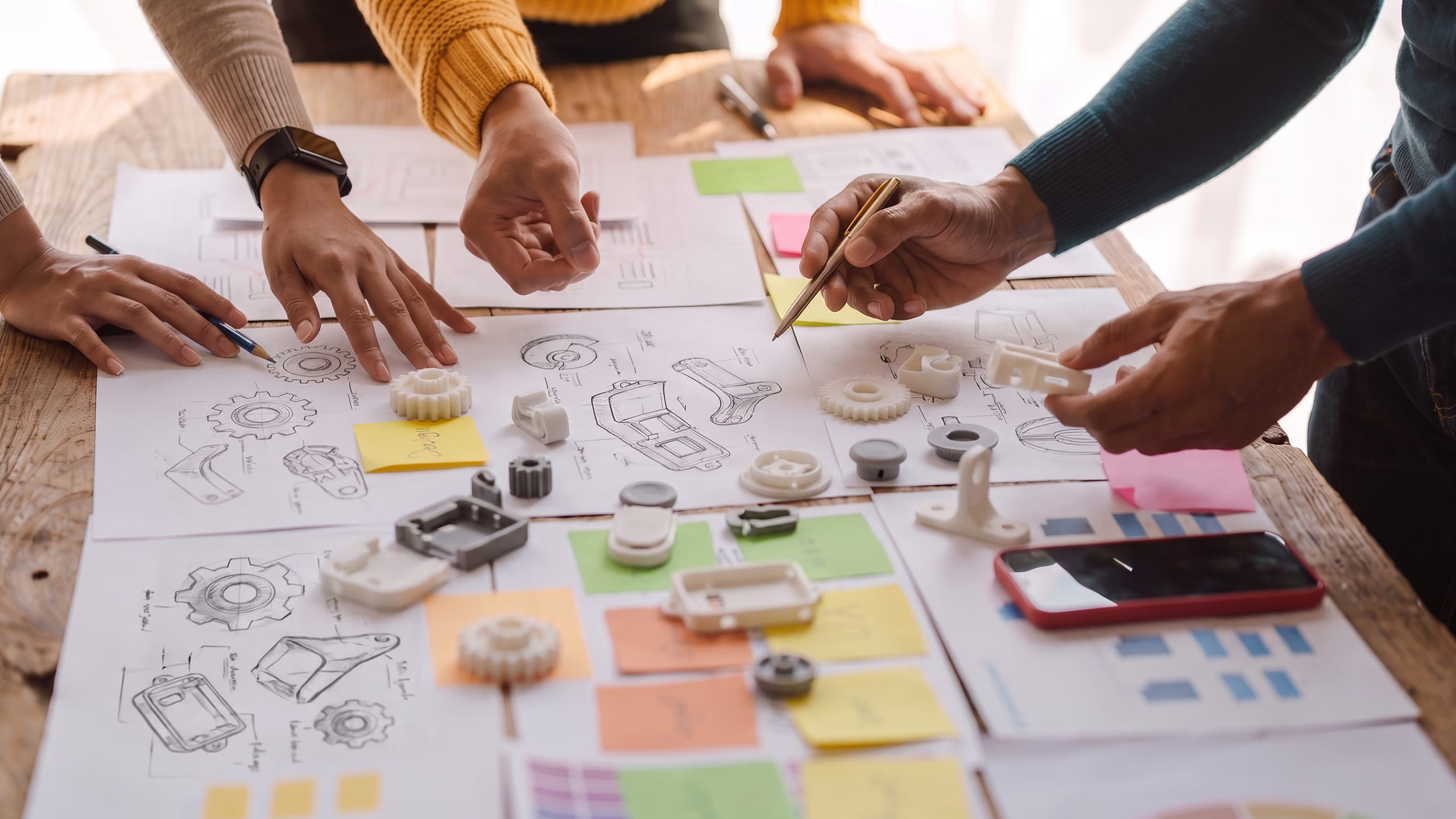
The point of an early model is to answer the biggest unknown for the least possible outlay. At the very start, when the idea is still forming, it is smart to build something crude from off-the-shelf parts rather than making it from scratch. Basic prototypes and proof of principle prototypes belong at this level. At this stage, it's not about trying to build the whole product, it's about proving, or disproving, the one thing the whole idea depends on, before any real resource is committed to it, in order to confirm the feasibility of the project.
The model does not need to look like the final product, be made from the final materials, or function like the finished article. It needs to test the one thing that matters, and nothing more.
Why the order matters
This is the mindset of good early product development: spend as little as possible to answer the question that matters most. Get that answer early, and everything that follows is built on solid ground. Get it late, or not at all, and you risk carrying a fundamental flaw all the way to production, where it becomes the most expensive kind of surprise.
The alternative, the mistake we see often, is building a full looks-like, works-like prototype first, only to find the basic principle does not hold. By that point, months and a significant sum have gone into a model that has failed at the first question it should have been asked. Testing the riskiest part first is simply the cheapest route to the truth about the fundamental feasibility of the concept.
To see where this fits in the wider process, read our full guide to prototype development. For the rough models this principle relies on, see low fidelity prototypes in product design.