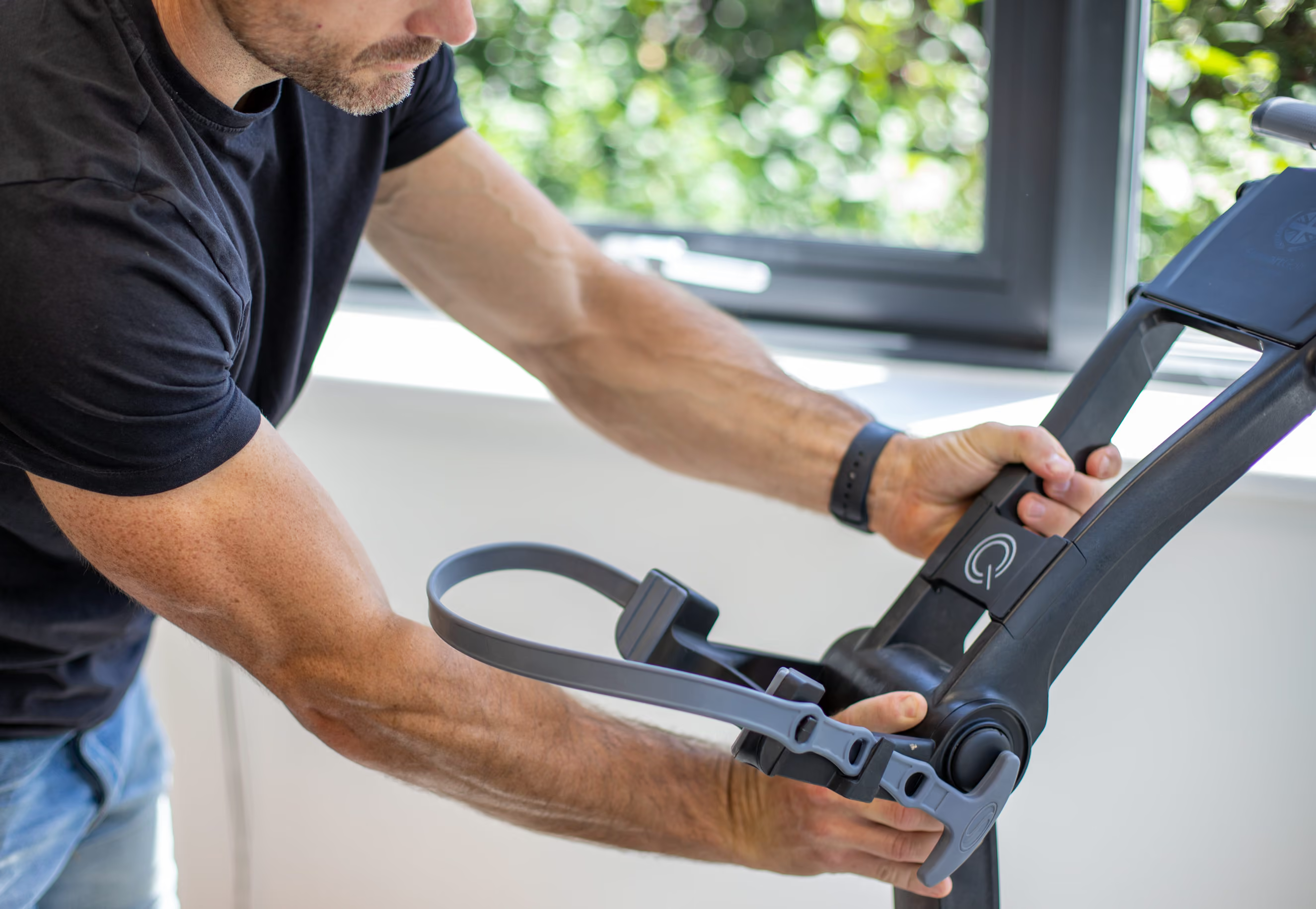
Mechanical product design is the engineering side of developing a product: the mechanisms, structures, tolerances and materials that make it work reliably, not just look right. It combines creative design with engineering rigour so that moving parts function, components fit, and the whole thing can be manufactured at scale. This guide explains what it involves, why it matters commercially, and how we approach it, with examples of mechanisms we have taken through to production.
Plenty of products live or die on how well their mechanical design is resolved. A folding mechanism that jams, a blade that dulls too quickly, a hinge that loosens after a month of use, these are not styling problems, they are mechanical ones, and they are far cheaper to solve on screen than after tooling. Mechanical product design is the discipline that gets them right: taking a concept and engineering it into something that works dependably, fits together correctly, and can be produced efficiently.
This is where much of the real risk in a project sits, and it is where our focus tends to concentrate. Alongside the wider product design process, which covers the journey from research to launch, this guide looks specifically at the engineering dimension: the mechanisms, the loads, the tolerances and the material choices that decide whether a product performs.
What mechanical product design is
Mechanical product design is the creation of functional, reliable physical products through the application of engineering principles. Unlike purely aesthetic design, which is concerned with how a product looks, mechanical design is concerned with how it works: the structures and mechanisms that deliver its function, the way it holds up under real-world load, and whether it can be made safely and consistently.
It draws on 3D CAD, material science and a working knowledge of manufacturing processes. The key part of many products is mechanical at heart, a cutting blade, a folding mechanism, a drive system, and getting that part right is what the discipline exists to do.
The engineering dimension, stage by stage
The mechanical work runs alongside the broader design process, but a few stages are where it does its heavy lifting.
Research and technical feasibility
Before design begins in earnest, the technical ground needs testing. This means establishing the material properties the product will need, the regulatory standards it must meet, and the performance constraints it has to work within. Defining the problem precisely, what the product must do, how durable it needs to be, how it will be used, is what keeps the engineering focused on the right targets.
CAD, simulation and analysis
Computer-aided design is the core tool of mechanical design. Detailed 3D models let a designer develop full assemblies and see how parts interact before anything physical is made. Crucially, those models can be analysed: simulation tools evaluate stress, thermal effects and mechanical load, so weaknesses can be found and resolved on screen rather than discovered in a broken prototype. Tolerance analysis checks that components will fit and function together once they carry the variations of real manufacturing. This stage often reveals how to simplify a design, strengthen it, or take cost out of it.
Prototyping and functional testing
Mechanical design has to be proven physically. Prototypes, made by 3D printing, CNC machining or laser cutting depending on the part, are built and then tested under the conditions the product will actually face: mechanical strength, durability, and ease of use. Watching real users interact with a mechanism surfaces problems that are invisible on a screen, and each round of testing feeds refinements back into the design.
Design for manufacture
A mechanism that works in the workshop is only half the job; it also has to be made economically and repeatably. Design for manufacture is where the design is optimised for production: selecting materials that meet the performance requirement while remaining feasible to source and cost-effective, choosing the right process, whether injection moulding, stamping or a particular assembly method, and reducing part count and complexity where it can be done without compromising function. Fewer parts mean lower cost and simpler, more reliable assembly.
Final design and documentation
The mechanical design is then captured in the detail a factory needs: technical drawings, assembly instructions, and a specification that defines materials, tolerances and quality standards. A clear manufacturing specification is what lets a manufacturer quote and build accurately rather than filling gaps with guesswork.
Why it matters commercially
Good mechanical design is not an engineering indulgence; it protects the commercial case for the product. It delivers functional reliability, which matters for user safety and satisfaction and is the foundation of any repeat purchase. It builds in durability, so the product withstands the wear it will meet in use. It makes production more efficient, because a well-engineered design simplifies manufacture, reduces waste and lowers unit cost. And it reduces the risk of the expensive failures, mechanisms that fail in the field, parts that will not assemble, that can undo a product after launch.
Mechanisms we have taken to production
The discipline shows most clearly in products that hinge on a mechanism.
The Avery trimmer and guillotine range is a good example of mechanical design at the centre of a product. Cutting products depend on the blade mechanism working precisely and safely over thousands of cycles, which places real demands on the engineering: the cutting action, the geometry, the tolerances and the materials all have to hold up to repeated use without losing accuracy or becoming a safety risk.
Wrap 2.0 is another where the mechanical design carries the product. Getting the mechanism and structure resolved so that it performs consistently, and can be manufactured reliably, is exactly the kind of engineering challenge mechanical product design exists to solve.
In both, the same principle applies: prove the mechanism early, engineer it for manufacture, and the product reaches the market as something that works dependably rather than something that looks right but fails in the hand.
How D2M can help
We specialise in turning mechanical concepts into functional, manufacturable products. Our designers and engineers handle the research and technical feasibility that set a project on solid foundations, the CAD, simulation and prototyping that resolve how a product works, and the design-for-manufacture work that makes it economical to produce. Because we understand both the engineering and the commercial realities, we develop mechanical designs that are reliable in use and practical to make, minimising your risk at the point where products most often go wrong.
In short
Mechanical product design is the engineering discipline behind a product that works: mechanisms, structures, tolerances and materials, resolved through CAD, simulation, prototyping and design for manufacture. It is where much of a project's risk sits, and getting it right is what makes a product reliable in use and economical to produce. Proven early and engineered for manufacture, good mechanical design is what lets a product perform in the hand as well as it does on the screen.
Related guides: Product Design Process · Prototype Development · Manufacturing Specification · Value Engineering
See it in practice: Avery Trimmer & Guillotine Range · Wrap 2.0
FAQ
What is an example of mechanical product design? A folding chair is a simple one: it uses hinges and levers to collapse and expand, and the design has to balance stability, weight capacity and ease of use. Any product with moving parts, a trimmer, a pushchair, a drive system, relies on mechanical design.
Why is prototyping important in mechanical design? It lets you test function, strength and durability, and gather user feedback, before committing to tooling. Mechanical problems are far cheaper to fix in a prototype than in production.
What role does CAD play? CAD is central: it is used to build detailed 3D models, run simulations for stress and load, and analyse tolerances, so problems are resolved before physical parts are made.
How does design for manufacture help? It optimises the design for efficient, cost-effective production, identifying the right materials and processes early, simplifying assembly, and reducing cost without compromising quality.