Finding a UK manufacturer is less about searching and more about qualifying. Before you approach anyone, your design needs to be production-ready, because a factory quotes what it is given. From there the task is knowing where to look, matching a factory to your volume, reading a quote properly, and watching for the red flags that appear early. This guide also sets out the real advantages of UK production and when it is the right call, because the honest answer is that it suits some products and not others.
Plenty of UK factories exist, so finding one is rarely the hard part. The hard part is qualifying: making sure you approach the right factory, in the right way, with a design complete enough to price, and reading what comes back closely enough to compare it properly. Get that qualification right and a UK manufacturer can be a genuine asset. Get it wrong and you can commit to tooling with a factory that was never the right fit.
This guide sets out how to find and qualify a UK manufacturer, from what to prepare before you make contact, through where to look and what to ask, to the honest question of whether UK production is right for your product at all.
Get production-ready before you approach anyone
A factory cannot quote a sketch. Before you approach any manufacturer, UK or otherwise, you need fully developed CAD files, technical drawings, complete specifications and material details, because that is what allows a factory to understand the parts, the assembly and the materials well enough to build a price. Sending anything less puts you at the back of the queue, because you are effectively asking the factory to do your development work before you have given it any commitment.
The document that pulls this together is the manufacturing specification, written for the factory rather than for your design team, and our guide to the manufacturing specification covers what it needs to contain.
Where to look for a UK manufacturer
Finding candidates is the most straightforward stage. UK manufacturer directories such as Make It British are a sensible starting point, alongside trade shows, industry referrals and recommendations from a design partner who has placed work with UK factories before. Once you have a shortlist, contact each factory, request samples of comparable work, and compare their capabilities rather than only their prices.
A referral from someone who has manufactured a similar product carries more weight than a directory listing, because it comes with a track record attached. This is one of the practical reasons a design partner earns their place: knowing which UK factories are genuinely capable of a specific kind of work is knowledge built over years of placing projects, not something a directory can tell you.
Match the factory to your product and volume
A common reason enquiries go unanswered has nothing to do with rudeness. A factory has to operate continuously and bill its time, so if you arrive with a complex task, ask for hours of engineering effort just to produce a quote, and then signal a very low production quantity, the order will not deliver enough profit to justify the effort, and you will not hear back.
Two things address this. First, match the factory to your volume: understand what quantities a factory is set up for before contacting it, and if it is built for mass production while you need small batches, find one that handles small batches. Second, work with the factory's existing production line rather than asking it to adapt to you, because a factory that can make your product within its current setup will engage far more readily than one being asked to alter its line for a single job.
Reading a quote properly
When quotes come back, the most important discipline is refusing to compare price until you have confirmed you are comparing the same thing. Manufacturing method and tooling approach change cost significantly, so before you look at the numbers, confirm that the manufacturing method, the tooling material, the tooling technique and the descriptions match across every quote. Only then does a price comparison mean anything.
There is a useful way to test a factory's capability at the same time. Sending a deliberately flawed model and seeing whether the factory flags the issue or simply quotes for it tells you a great deal, because a factory that quotes a flawed part without questioning it has shown you how closely it actually reads what it is given.
Red flags to watch for
The warning signs show up in how a factory handles technical detail. A factory that says yes to everything but cannot engage when you ask a genuinely technical question is a concern, because it may be agreeing to something it does not fully understand. If it cannot discuss your material requirements, or the complications specific to your product, that is worth noticing. During tooling, small unilateral decisions are another signal: a tool being built with a different material or technique from the one described in the proposal is a reason to pause and ask questions before going further.
Protect your design before you share it
If your design carries intellectual property worth protecting, file the application, or at least submit it, before you share anything, and sign an NDA with everyone involved, including the factory. On first contact it is sensible to send a simplified model that holds back the detail which makes your product distinctive, because it is enough for the factory to demonstrate how it works while keeping your most valuable detail back until there is commitment on both sides. On tooling, the position is simple: you pay for the moulds, so you own them, wherever they physically sit.
The real advantages of UK production
Producing in the UK carries genuine advantages that matter for the right product. Communication is easier and faster, because there is no significant language barrier or time-zone gap, which makes troubleshooting quicker when something needs resolving. Lead times are typically shorter, and quality control is easier to oversee when production is close enough to visit. UK manufacturers are generally subject to strict quality standards and regulation, legal protection is more straightforward to enforce, and for some brands the provenance of UK manufacture is part of the product's appeal. Small, limited production batches are also well suited to UK production, and can support a brand built around exclusivity and lower waste.
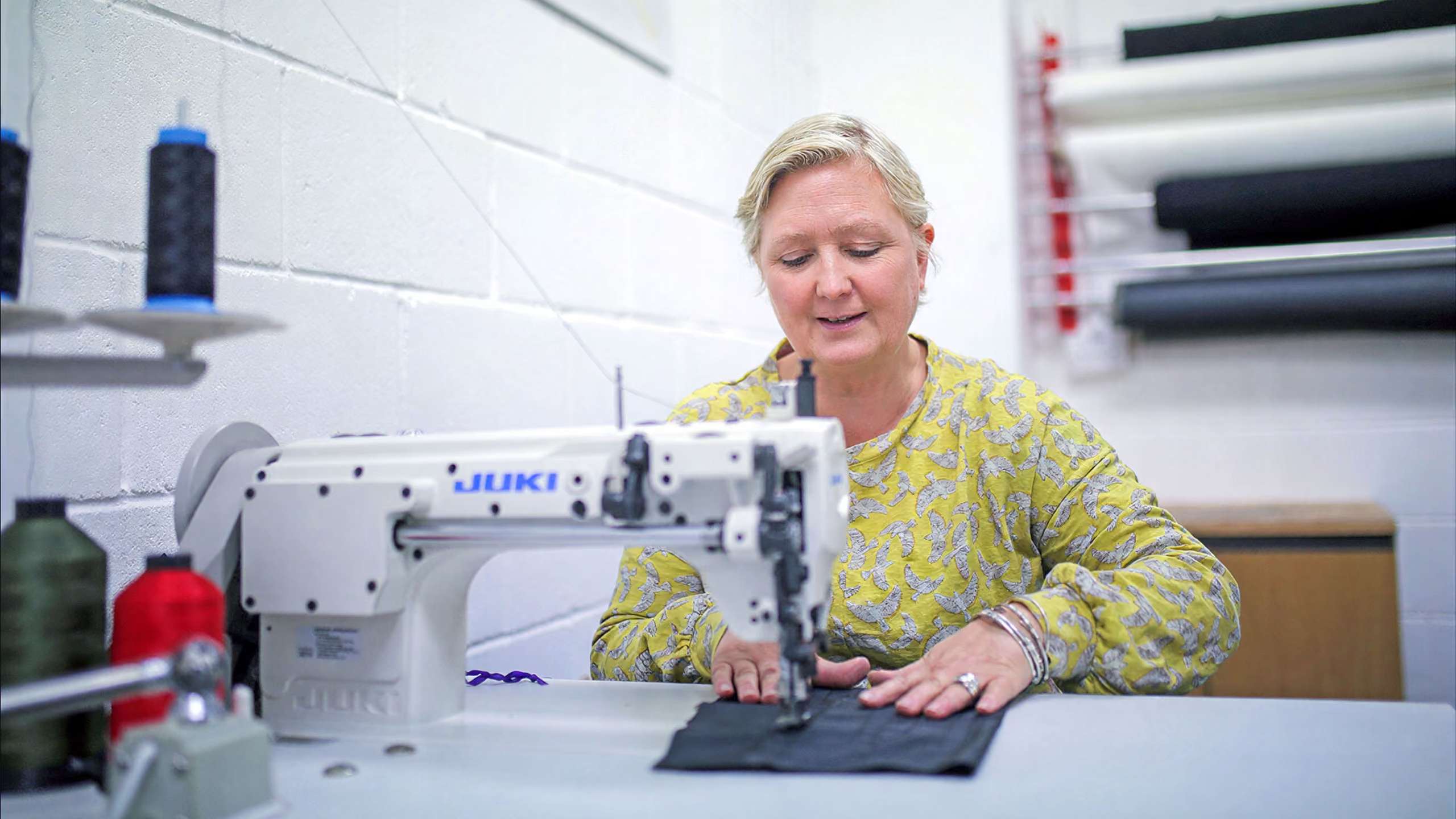
We saw this with Baxley Bags, a range crafted in Sussex from locally sourced waxed canvas using traditional British manufacturing. We worked with the brand to develop the final prototype and manufacturing specification and to prepare the product for UK production, and the range now sells in small, limited batches that reduce waste and build anticipation around each release. UK production was the right answer there because it fitted the product and the brand, not by default.
When UK production is the right call, and when it is not
The honest position is that UK production suits some products and not others. It is well matched to complex products that benefit from hands-on troubleshooting, to small or limited batch runs, to products where quality oversight and provenance matter, and to brands that value speed and close communication over the lowest possible unit cost.
For straightforward, high-volume products, UK manufacture is more expensive, and some products cannot be made here at all, because the supply chain or the specialist equipment no longer exists domestically. One of the most common early lessons is a UK quote that comes back at well above expectation, which is a sign not that the search failed but that the product may belong to a different production route. Where cost is the binding constraint on a simple, high-volume product, overseas production is often the better answer, and our guide to choosing a manufacturing location covers that decision in full.
How D2M helps
We are a product design consultancy with fifteen years of experience, and over more than 1,600 projects we have placed work with UK and overseas manufacturers across a wide range of sectors. Because we design with production in mind from the outset, and hold direct relationships with vetted UK factories, we can point clients toward manufacturers genuinely capable of their kind of product rather than leaving them to qualify a directory list alone. Whether UK production is the right route is a question we answer honestly against the product in front of us, through the same commercial-viability lens that runs through all our work.
In short
Finding a UK manufacturer is less about searching and more about qualifying. Arrive with your design production-ready and a proper specification. Use directories, referrals and trade shows to build a shortlist, then match a factory to your volume and read its quotes on method before price. Watch how a factory handles technical detail, and protect your IP before you share anything. Above all, be honest about whether UK production genuinely suits your product, because for the right product it is a real advantage, and for the wrong one it is an expensive detour.
Related guides: How to Find the Right Manufacturer · Who Can Help You Find and Manage a Manufacturer · Choosing a Manufacturing Location · Manufacturing Specification