Apple's success rests on a handful of product design principles that any business can apply, whatever its size or sector: an obsession with quality, genuine empathy for the user, solving real problems, making products intuitive to use, and giving the early concept work the time it needs. None of them require Apple's budget. This guide sets out what those five lessons mean in practice.
Apple is, by most measures, one of the most successful product design companies in the world, and it did not get there by making mediocre products. For a long time its design approach was closely guarded, but enough has since been written about how the company works to draw out the principles behind it. What is striking is how few of them depend on scale. They are lessons a start-up developing its first product can apply just as readily as a corporation.
Here are five worth taking to heart.
Focus on developing quality products
This sounds obvious, but quality is easily misunderstood. A quality product is not simply one that looks good in a listing or uses durable materials. Quality products solve a real problem, are easy to use, look excellent, come at a sensible price, and lead rather than follow in their field.
What comes through consistently about Apple is a near-obsessive focus on getting the product right, at the most senior level of the company. If you want to lead on quality in your own market, that focus cannot be delegated away or treated as a finishing touch. It has to sit at the centre of how the product is developed.
Have empathy for the end user
How the end user feels about your product decides whether it succeeds. Customers and retailers are what make a product business work, so they cannot be an afterthought at any point in the design process. Apple's design work is marked by a deep, deliberate empathy for the people who use its products: an intimate understanding of what they need, what frustrates them, and how they will actually use the thing in their hands.
Designing with that same empathy, rather than designing for your own preferences, is what leads to the decisions that make a product resonate.
Create useful and meaningful solutions
A great many products are developed simply because they can be, new features for the sake of newness. The more valuable discipline is to solve a genuine problem in the customer's life. It is one thing to make something that looks clever or novel; it is much harder, and much more rewarding, to make something people want to use every day and are happy to pay a premium for.
That comes from understanding the customer's problem deeply and designing specifically to solve it, while delivering an experience good enough that they come back.
Build intuitive and simple products
Most people have unboxed a product and been immediately unsure how to use it, reaching for a badly written manual to get it working. It is a poor first impression, and it wastes the customer's time. People are busy; they do not want to work your product out.
You may have a vision for a wealth of features or advanced technology, but if the user does not find the product intuitive, none of it matters. Apple's devices are designed relentlessly towards ease of use, to the point that a child can often pick one up and understand it. Simplicity of that kind is not the absence of effort; it is the result of a great deal of it.
Don't rush the early development
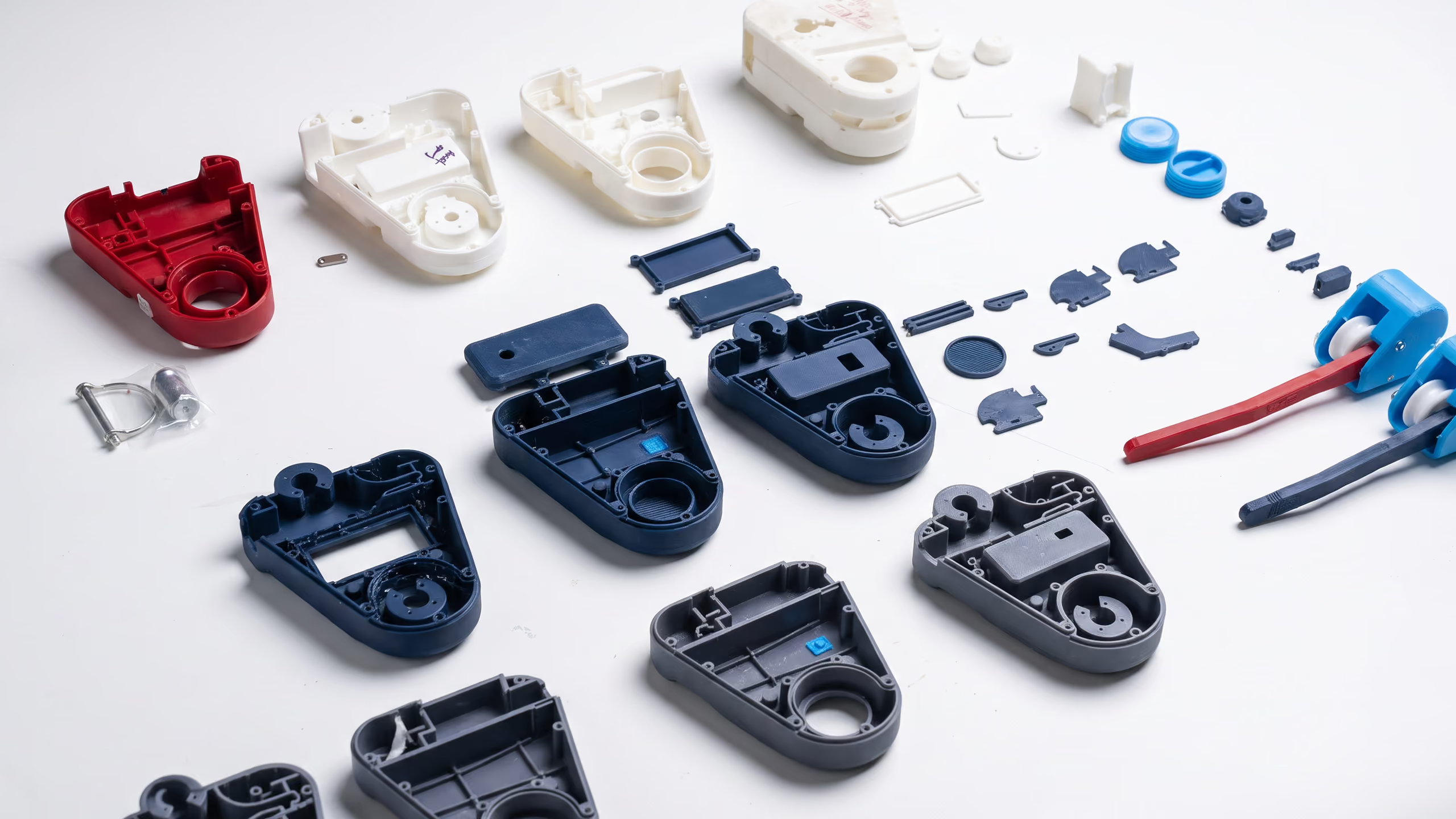
Good ideas take time to form, and good product design usually takes many prototypes. The early stage is exactly where you should resist nailing things down too quickly. Apple has been described as using a "10-3-1" approach to narrow its thinking: the team generates ten strong concepts using open, ambitious thinking, reviews and narrows those to the three most viable, then refines those three down to the single idea with the best potential, the most user benefit, and the most practical route to production.
The lesson is to open the field wide at the start, generate as many concepts as you can, and then apply critical, rational judgement to arrive at the strongest one. Limiting yourself too early is how good products are quietly lost before they begin.
Getting to a strong concept is easier with more minds on the problem, which is the thinking behind our innovation workshops: focused sessions where our design team generates a wide range of ideas for a product, whether that is a first concept, the start of a range, or the next generation of an existing product.
In short
Apple's product design lessons come down to five things any business can apply: obsess over genuine quality, design with real empathy for the user, solve meaningful problems rather than chasing novelty, make the product intuitive, and give the early concept work the time and breadth it needs. None of them require a vast budget, only the discipline to hold to them.
Related guides: Product Design Process · Product Idea Design · Mechanical Product Design
FAQ
What are the five lessons from Apple's design process? Focus on real quality, have empathy for the end user, create useful and meaningful solutions, build intuitive and simple products, and don't rush the early concept work.
What is the 10-3-1 method? An approach to narrowing ideas: generate ten strong concepts, reduce them to the three most viable, then refine those to the single best. It keeps early thinking broad before applying rational judgement.
Do these lessons only apply to large companies? No. None of them depend on scale. A start-up developing its first product can apply the same principles as a corporation.